Listening for Change: The Transformative Power of Community Organizing
As dusk draped its heavy shadows over the jagged ridges of Tejutla, Guadalupe Ramirez would stand by the window, her breath shallow against the glass, listening. She was waiting for the sound of the agricultural cooperative’s battered Land Rover climbing the uneven dirt road home, bringing her father back from his meetings. Long before its dim yellow headlights cut through the gathering dark, she would hear the engine—strained, rattling, yet profoundly familiar. On some evenings, that mechanical growl brought a wave of immense relief, a signal that her world remained intact. On others, the sound was a vessel for unspoken dread.
By that time in the village's history, several members of the cooperative had already been disappeared. Everyone in the highlands understood the brutal calculus of this reality. Men who organized rural farmers, who met—whether in secret or in public—to discuss land rights, equitable credit, fair wages, and human dignity, could simply vanish into the night. The violence was not a distant political abstraction; it was an atmospheric tension that moved through the community like weather. It was unpredictable, violently intimate, and always hovering near. For a child like Guadalupe, fear did not exist as a concept; it settled deeply into the body as a state of perpetual listening. She listened for the strain of an engine. She listened for the rhythm of footsteps on the path. She listened for the fragile proof that the people she loved most had survived the world for one more night.
That is where this critical inquiry begins: not with a disembodied theory of international development or an abstract institutional report, but with a young girl at a window in San Marcos, waiting for her father to return from work that had become lethal precisely because it offered marginalized Indigenous and campesino families a tangible way to imagine their lives differently.
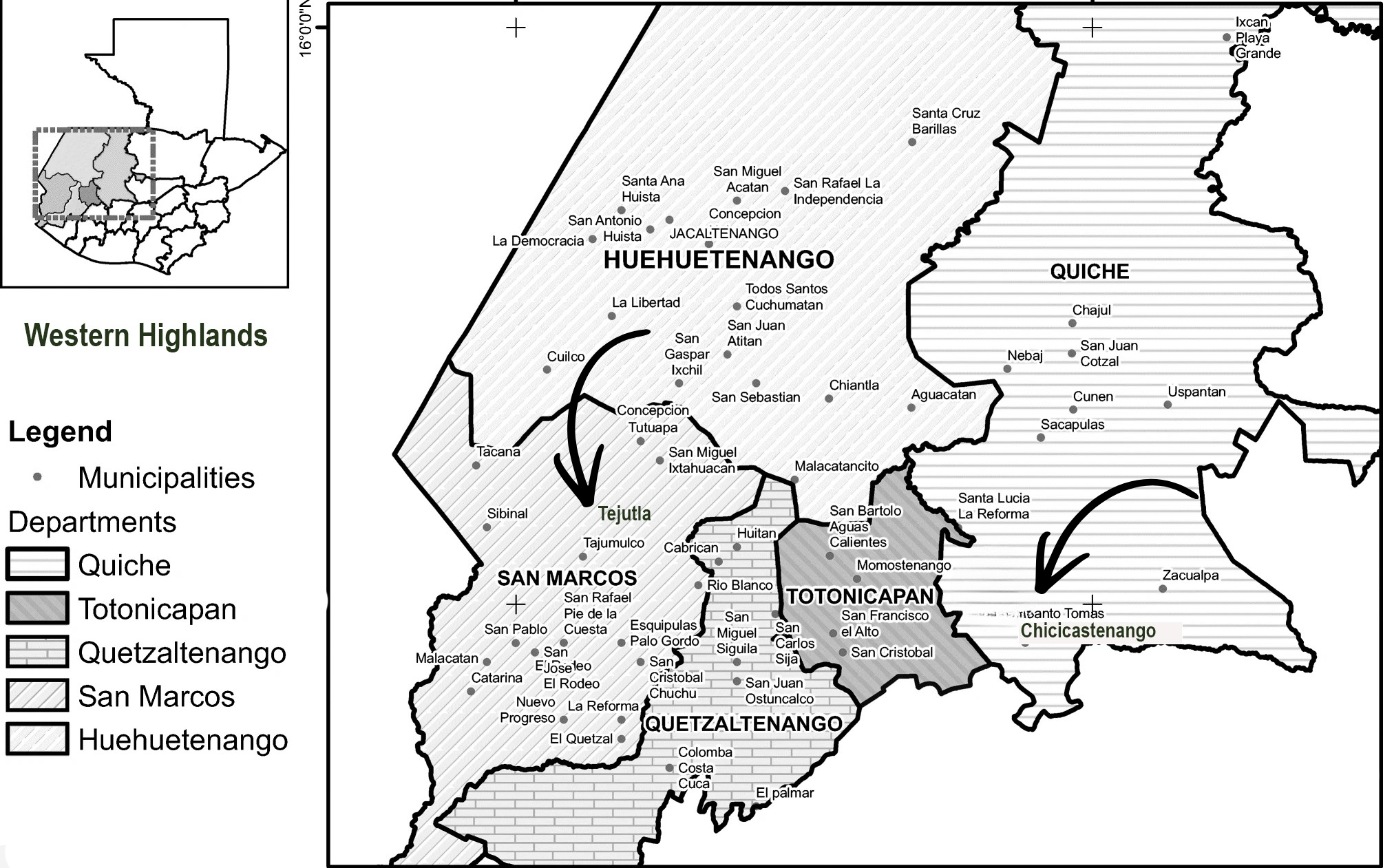
Map of municipalities in the Western Highlands of Guatemala with arrows indicating two communities engaged in this dissertation.
Note. Adapted from Lopez-Ridaura, S., Barba-Escoto, L., Reyna, C., Hellin, J., Gerard, B., & van Wijk, M. (2019). Food Security, 11, 817–833. https://doi.org/10.1007/s12571-019-00940-z. Modified to include arrows indicating the two communities discussed in this dissertation. Reproduced under the terms of the Creative Commons Attribution 4.0 International License (http://creativecommons.org/licenses/by/4.0/).
The Anatomy of the Soul Wound
What makes one path lead toward liberation while another deepens dependence?
That question sits at the heart of Guadalupe’s story. It is not an abstract question about development models or religious institutions. It rises from the ground of lived experience: from a family marked by grief, from a community shaped by abandonment, and from a single generation in which girls who might once have been expected to endure hardship in silence became educators, accountants, business leaders, and engineers. To ask how this happened is to ask what kind of intervention actually restores life. It is also to ask why some forms of help, even when well-funded and sincere, leave the deeper structures of power untouched.
Guadalupe grew up inside a struggle that far exceeded the boundaries of any one household, though its force was always felt most intimately at home. Her family carried the memory of loss in ways both material and spiritual. Her great-grandmother had fled up the mountains to escape bondage on a coastal coffee plantation, leaving behind one regime of exploitation only to enter another life shaped by scarcity, isolation, and hard survival. That flight became part of the family’s inheritance: a story of endurance, yes, but also of what it meant for Indigenous families to make life in highland spaces under conditions not of their choosing.
By the time of Guadalupe’s grandmother, Adriana, that inheritance had become even heavier. Adriana lost all but one of her children to diseases that should not have been fatal. The nearest hospital was a full day’s walk away. In that fact alone, one sees the architecture of structural abandonment. These were not random tragedies. They were the slow violence of neglect, the kind that settles into community memory until suffering begins to feel ordinary. Children die. Women grieve. Families keep moving. The world does not come.
This is the terrain that Eduardo and Bonnie Duran help name with the phrase “soul wound” 1. The soul wound is not simply pain remembered. It is the cumulative injury of colonization: land dispossession, systemic violence, cultural erasure, and the fracture of collective self-determination across generations. It lives in the body and in the social world at once. It teaches people to survive inside a world that has already decided their suffering is natural. In Guadalupe’s community, that wound appeared not only in poverty itself, but in the moral framework that poverty produced. You worked, you prayed, and you endured. Hunger was not questioned. Exhaustion was not politicized. Humiliation was folded into duty. The terms of life had become so narrow that deprivation could be mistaken for destiny.
Yet even in that older moral world, something restless remained. Beneath the discipline of survival was a quieter knowing: that human life was not meant to be organized around endless exhaustion, and that misery was not sacred simply because it had lasted a long time. The question was how that buried knowledge could become collective action.
The answer, in Tejutla, did not begin with charity. Outsiders had come before. Foreign missions, aid projects, and visiting benefactors had crossed those mountains carrying supplies, sermons, or development schemes. But most left intact the same hierarchy they claimed to address. They delivered assistance without redistributing power. They offered services while keeping communities in the position of recipients. They soothed symptoms and often generated gratitude, but they did not create the conditions for people to become protagonists of their own future.
What changed in the late 1960s and 1970s was something more difficult and more transformative: the arrival of Belgian missionaries and lay organizers shaped by Catholic Action and the Young Christian Workers movement. Their contribution was not primarily financial. It was pedagogical, relational, and political in the deepest sense. They brought a different grammar of faith.
That grammar began with a radical proposition: poverty was not a divine mandate. It was not the natural order of things. It was a social condition, produced by history and therefore open to change. Through the See-Judge-Act method associated with Jozef Cardijn and the Young Christian Workers, communities were encouraged first to see their reality clearly, then to judge it against a moral vision of human dignity, and finally to act together to transform it. This was not theology as abstraction. It was theology as a method for recovering perception. People were invited to look again at the world they had inherited and ask whether it had ever been just.
For Guadalupe, this awakening unfolded through ordinary spaces: kitchen conversations, prayer meetings, shared labor, and cooperative assemblies. As a child, she worked alongside Belgian nuns and local organizers. The work itself mattered, but so did the atmosphere around it. Something new was taking shape in those encounters. Faith was no longer only about enduring suffering with humility; it became a language for naming injustice and building collective capacity. The church was not merely a building in the city or a hierarchy far away. It was the people themselves, gathered in relation, discerning how to live differently.
This shift mattered because it touched the deepest layer of the soul wound. Colonization does not only take land and labor. It attacks the very conditions under which people can imagine themselves as agents of history. It narrows what seems possible. It trains perception so that domination appears normal and resistance appears unrealistic. Against that narrowing, the Belgian mission and its local partners helped restore a sense of authorship. They did not tell the community what its future should be. They created space for the community to analyze its own conditions and organize its own response.
That work took institutional form in the cooperative movement. The cooperative became far more than an economic mechanism. It was a social and moral reorganization of power. Local farmers, supported by Belgian clergy and lay workers but guided by their own priorities, began to build structures that could withstand the vulnerabilities imposed by isolation and exclusion. They organized around shared material constraints such as lack of agricultural credit, limited access to markets, and the absence of state support. In 1967, this organizing crystallized in a grassroots campesino movement that later evolved and formalized through a series of assemblies across the region.
The cooperative’s significance lay in how power moved through it. Guatemalan voices guided decisions. Local people pooled resources, controlled supply chains, and identified leverage points that could alter the community’s economic future. One such decision involved organizing the transport of wheat to distant markets. It was a practical solution, but also more than that. It showed what became possible once people ceased waiting for outside rescue and began building coordinated systems of their own. The cooperative became a living archive of hope: a place where inherited suffering could be reworked into strategy, where solidarity became infrastructure rather than sentiment.
This approach also transformed domestic life. One powerful example was the training of Guadalupe’s grandfather, Miguel, to build indoor cookstoves. This intervention addressed a primary source of respiratory illness and child mortality in the community. Miguel built the first stove as a wedding gift for his daughter-in-law. Over time, Guadalupe herself helped guide the construction of thousands more. The meaning of this legacy is easy to miss if viewed only as a technical improvement. It was not a charity giveaway detached from local knowledge. It was part of a broader praxis in which communities learned to identify the roots of suffering and mobilize their own skills to change daily life. The stove was not just an object. It was evidence that structural conditions could be altered through organized action.
This is why the contrast with the Methodist mission assemblage is so revealing. Both the Methodists and the Catholics were, in many cases, motivated by sincere commitments to justice and compassion. The difference was not moral character. It was method. The Methodist assemblage, despite receiving far greater external funding, remained fragmented and engaged in service delivery rather than empowerment. Its programs did not generate the same durable forms of local agency. Power remained tied to donor expectations, professional management, and outside control. Even when services were beneficial, they did not consolidate community sovereignty.
The Catholics, by contrast, practiced what might be called transferential agency: a deliberate stepping back so that local people could become decision-makers rather than clients. This meant that change emerged from within the community’s own analysis, labor, and institutions. The result was not simply better service delivery. It was a different social reality. One model distributed goods. The other generated agency.
That distinction becomes clearest when we look at the outcomes for girls and women in Guadalupe’s generation.
Only one generation separated Adriana’s grief from her granddaughters’ professional achievements. This is the part of the story that demands our deepest attention. A grandmother who lost nearly all her children to preventable disease lived long enough to see a radically different horizon open before the girls in her family. Guadalupe became one of five highly educated and successful sisters. One earned a master’s degree in education and now serves the cooperative’s elementary school. Another became a CPA. A third earned an MBA and manages the family’s tombstone business. The youngest, with a master’s in chemical engineering, works to empower women through food entrepreneurship. Guadalupe herself became part of the ongoing labor of community transformation.
This is not a sentimental success story. It is material, structural, and historically specific. These outcomes did not arise because opportunity naturally expanded over time. They emerged because a community built institutions capable of interrupting the reproduction of loss. Girls who might have inherited only survival skills inherited analysis, organization, and a sense of possibility. They grew up in a world where poverty had been redefined—not as fate, but as a condition people could confront together.
The transformation of these women is especially significant because colonial and patriarchal systems so often confine girls’ futures first and most severely. When a community changes the life chances of its daughters within a single generation, it has done more than improve household income. It has altered the grammar of the possible. It has changed who gets to imagine a future, who gets to study, who gets to lead, and who gets to shape the terms of community life.
This is why Guadalupe’s story matters beyond her family. It offers a clear answer to the question that drove this investigation. Some paths lead toward liberation by honoring sovereignty in everyday life. They do not treat communities as mere recipients of aid. They cultivate the relational, material, and moral conditions that enable people to become authors of their own transformation. Other paths, even generous ones, perpetuate dependence by retaining control elsewhere. They externalize decision-making, fragment local power, and confuse care with command.
The lesson here is not that outside accompaniment is always harmful, nor that resources do not matter. They do. But resources alone cannot heal the soul wound. Capital cannot substitute for collective agency. Programs cannot replace the slow work of rebuilding a people’s belief in its own capacity to interpret reality and act on it. Sustainable change requires more than assistance; it requires structures that return voice, authority, and initiative to those who have long been denied them.
Guadalupe’s family history holds both wound and bridge. It begins in bondage, grief, and abandonment. It passes through a grandmother’s unimaginable losses. It moves through the patient work of consciousness-raising, cooperative organizing, and practical innovation. And it arrives, within one generation, at a cohort of women whose lives testify to another world having become possible.
That is the deeper significance of the Belgian mission’s contribution. It did not save the community. It helped the community recover itself. It helped create the conditions in which people could say, with grounded conviction rather than borrowed hope, "Sí se puede."
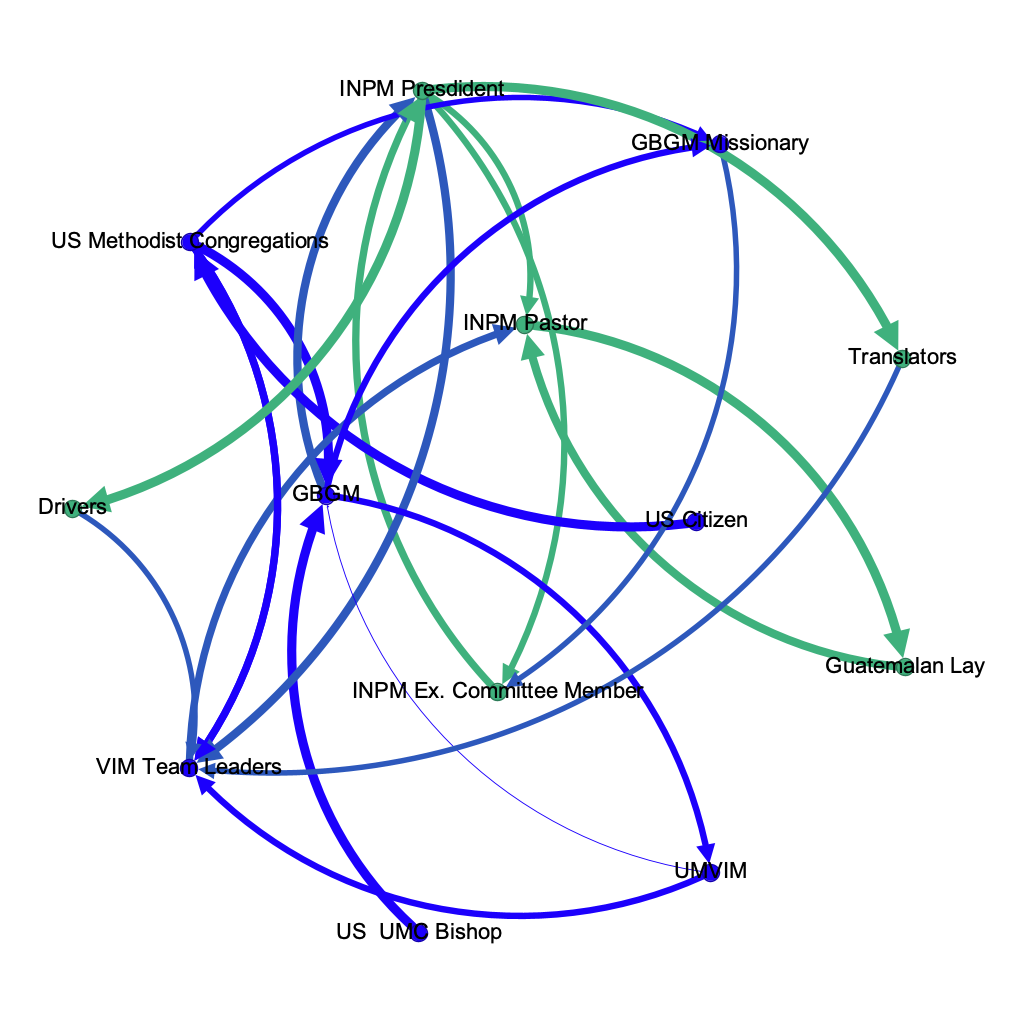
A Gephi visualization of the Methodist mission assemblage in Western Guatemala pre-2000. In this diagram, the blue nodes designate foreign actors, while the green nodes represent local native actors. This visualization highlights the central role of native organizations and the structural stability.
The Method of Inquiry: Mapping the Architecture of Power
To rigorously interrogate the structural roots of these divergent realities, this text draws upon a three-year PhD dissertation study conducted by Ben Blevins, participatory research coordinator for the Highland Support Project (HSP) and Guadalupe's husband. As someone deeply entwined in the Methodist Mission ecosystem operating in the Western Highlands, Blevins' research demands a humble, critical introspection regarding our own complicity in the systems we seek to change.
We must acknowledge that what "works" in community organizing often forces hard choices upon local leaders navigating donor expectations. This inquiry employs a precise, mixed-methods analytical framework informed by Actor-Network Theory. Central to this investigation is the use of Gephi, an advanced software tool designed for complex network visualization. By mathematically mapping the intricate webs of actors, funding flows, and institutional ties, Gephi makes the invisible architectures of power visually legible.
This structural mapping is paired with deep qualitative coding of organizational archives, reports, and field narratives, accomplished through Atlas.ti. By combining nuanced, manual human analysis with AI-assisted algorithmic coding, this comprehensive review systematically compares underlying perceptions and ideological biases across vast amounts of text. Together, these methodological devices actively dismantle the familiar narratives of humanitarian benevolence, offering empirical proof of how specific configurations of aid either cultivate genuine community agency or reproduce entrenched colonial dependency.
The Cardijn Formation: See, Judge, Act
We often locate our greatest collective strength when we prioritize the voices of those pushed to the margins. In the early twentieth century, a Belgian priest named Jozef Cardijn witnessed the deep suffering of working-class youth during rapid industrialization. He did not look away, nor did he offer mere pity. Instead, he helped build a movement centered on their inherent worth, recognizing that true structural change only materializes when communities are empowered to lead their own transformation.
During the early 1900s, industrial wealth in Belgium relied on the crushing exploitation of the working class. Cardijn felt a deep moral indignation at the wretched conditions of factory youth. He understood that top-down instruction and charity were insufficient; these young people required the space to realize their own power and build their own agency. Inspired by an unwavering commitment to human dignity, Cardijn founded the YCW movement in 1924, utilizing a transformative methodology that would eventually reach the Guatemalan highlands: See, Judge, Act.
This reflective framework fundamentally shifted how marginalized communities understood theology and collective power.
See: Cardijn encouraged people to look honestly at their lived reality, refusing the blur of custom and learned helplessness. They were asked to notice how land and resources were concentrated in the hands of a few.
Judge: Communities evaluated this reality against the conviction that poverty is not a divine mandate, but a social sin. This marked a profound departure from traditional, hierarchical instruction that urged quiet endurance.
Act: Crucially, faith and values could not remain private comforts. They had to translate into a tangible organization. Action became the disciplined, communal construction of local capacity through the formation of literacy circles, savings groups, and agricultural cooperatives.
When Belgian organizers traveled to Guatemala, they refused to view local people as passive recipients of aid. Guided by a deep respect for local agency, they recognized a profound resonance between their own history of class exclusion and the struggles of rural Guatemalan communities. Through the See-Judge-Act methodology, they worked collaboratively to build strong local organizations.
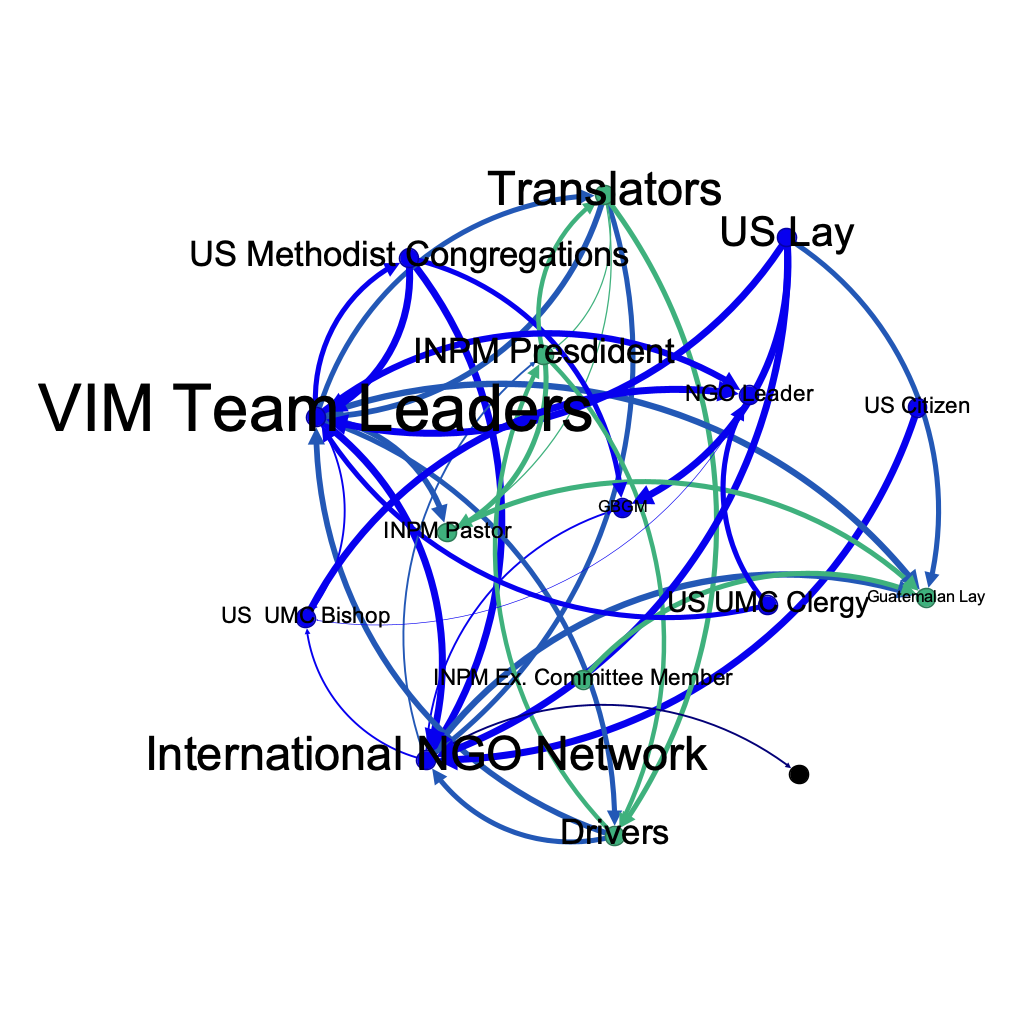
A Gephi visualization of the structural change in the Methodist Mission resource and power flow after 2000. Blue is foriegn run organization while green are native directed.
Decolonization is Not a Metaphor: Building Tangible Power
For Guadalupe and her community, this methodology was transformative because it touched the deepest contradiction of her childhood: society treated Indigenous suffering as ordinary, yet here was a framework insisting that this suffering had a history, and therefore, an end.
This brings us to a critical theoretical juncture. As Indigenous scholars Eve Tuck and K. Wayne Yang articulate, "decolonization is not a metaphor."2 It is not merely about improving representation, modifying language, or offering symbolic inclusion within existing colonial structures. Decolonization requires the actual repatriation of Indigenous land and life, and the tangible transfer of decision-making power.
The cooperative in Tejutla embodied this principle. It was not a performative space for foreign donors to feel benevolent; it was a mechanism for reclaiming material sovereignty. By enabling the transport of wheat to distant markets, the cooperative unlocked a leverage point that radically shifted the community’s fortunes. Profits from these strategic sales funded communal growth and individual dreams alike. Families pivoted from burying siblings lost to preventable illnessesto celebrating the achievements of daughters earning professional degrees. The cooperative’s struggle was about securing tangible decision-making power over their economy, their land, and their futures. It gave people a way to imagine a different life, proving that temporal and spatial foresight can literally rewrite futures.
The Divergent Realities of Aid: Accompaniment vs. Dependency
The Belgian Catholic presence in Tejutla mattered because it actively created the conditions for local people to become the uncontested agents of their own collective life. Its most enduring contribution was transferential agency—the deliberate, structural relinquishment of institutional authority by outsiders, enabling genuine co-creation and collective self-determination. Through the patient work of accompaniment, they helped nourish institutions that outlasted the missionaries themselves.
This outcome stands in sharp, painful contrast to other foreign religious-development models in Guatemala, particularly the US Methodist-affiliated service delivery models in regions like Chichicastenango. Both models entered Indigenous communities speaking the language of care. But they did not leave behind the same world. Where Tejutla generated durable communal infrastructure and local sovereignty, other frameworks reproduced dependency, fragmentation, and external control.
Through rigorous qualitative coding of organizational archives, we can observe the hidden frameworks of neoliberalism and coloniality operating within these service delivery models. Many modern NGOs rely heavily on the language of tourism—painting a picture of a captivating country populated by "warm and kind" yet inherently vulnerable people. By highlighting malnutrition and extreme poverty as mere unfortunate realities, devoid of historical context, they frame marginalization as a natural state of being. This deficit framing implies that Indigenous struggles are organic deficits requiring the intervention of benevolent outsiders, ignoring the direct results of historical colonial practices and systemic exclusion.
Furthermore, programs like "Becas con Misión" (Scholarships with a Mission) often base selection on individual "determination and grades," requiring students to maintain high averages to keep their funding. While appearing helpful, this meritocratic logic forces students to compete against one another for scarce resources, fostering an individualistic society whose hopes lie in the market rather than in community solidarity. It is a liberal framework of recognition 3—offering token representation while ensuring true power over capital and strategic direction remains in the Global North.
The Hidden Framework
When we look at the work of international mission organizations, we often see a narrative of hope, healing, and charity. Driven by a desire to support global development, these initiatives frequently provide essential short-term relief. However, a deeper, more earnest analysis of the language and structure used by mission organizations—such as those operating in the beautiful, resilient communities of Guatemala—reveals a much more complex reality. By examining the coding of these organizations' materials, we can see how well-intentioned aid often intertwines with neoliberal values and colonial power dynamics.
To truly collaborate with communities and foster sustainable, systemic change, we must first understand the invisible frameworks shaping these missions. Specifically, we must define two critical forces: neoliberalism and coloniality.
Neoliberalism is a framework that prioritizes market-based solutions, institutional efficiency, and individual responsibility over systemic reform and community welfare. It operates as a subtle force that presents corporate rationalities as progressive and inclusive, often masking an agenda that commodifies basic human rights. 4
Coloniality refers to the longstanding, intergenerational patterns of power that emerged during formal colonization and continue to define global life today. It is a system of hierarchy that dictates whose knowledge is valued, whose labor is extracted, and whose suffering is normalized. Coloniality disrupts the relational fabrics of Indigenous communities, replacing local self-determination with external dependency. 5
When these two frameworks merge within the context of global aid, they significantly alter how missions impact the local Mayan communities they aim to serve.
The Language of Tourism and the "Natural State" of Poverty
A primary way these frameworks manifest is through the language used to describe the communities being served. Mission materials often rely heavily on the language of tourism, painting a picture of a captivating country distinguished by its breathtaking natural beauty, majestic mountains, and serene lakes. Alongside this romanticized backdrop, the local people are frequently portrayed as "warm and kind," yet inherently vulnerable.
This framing serves a specific purpose: it creates a fantastic, exotic landscape populated by "worthy victims" in need of rescue, while remaining totally devoid of structural analysis. By highlighting infant mortality, malnutrition, and extreme poverty—which affects more than 80% of the population in regions like Quiché—as mere unfortunate realities, these organizations frame poverty and marginalization as a natural state of being.
This perspective implies that Indigenous struggles are organic deficits requiring the intervention of benevolent outsiders to be "fixed." In truth, these conditions are the direct result of historical and ongoing colonial practices, environmental degradation, and systemic exclusion. When missions ignore these root causes, their interventions risk fostering and perpetuating poverty rather than transforming it.
The Neoliberal Lens: Metrics, Corporate Framing, and the NGO Market
Neoliberalism in mission work shifts the focus from structural justice to individual responsibility and market-driven metrics. We see this clearly in how healthcare and education are structured, delivered, and reported.
Today, mission work operates within a fragmented, competitive NGO market. Rather than using informative, educational, or reflective language that empowers local communities, organizations frequently adopt a neoliberal corporate framing. They speak of operating for "maximum impact," tracking progress through quantifiable metrics like "4,205 medical and dental patients seen" or the construction of "over 2,000 stoves."
While tracking progress is necessary for accountability, tying success solely to operational metrics and cost-efficiency limits the scope of the work. It satisfies donor expectations and serves as a marketing mechanism, but it fails to address the root causes of marginalization. The institution that distributes mass-produced stoves without fostering local governance, or that counts meals served rather than autonomous capacity cultivated, is functioning precisely as designed for the needs of a donor constituency—not the local community.
Individualism, Competition, and Education as a Colonial Project
Many mission programs place the burden of success squarely on the individual. We see this in healthcare, where some clinics require patient donations or small fees for care under the guise of "promoting autonomy." This shifts the blame for poor health outcomes onto individuals, ignoring systemic barriers like inequitable food systems and a lack of public infrastructure.
In education, this individualism takes the form of competition. Programs like "Becas con Misión" (Scholarships with a Mission) base selection on "determination and grades," requiring students to maintain high averages to keep their funding. Providing the promise of “improving their competitiveness in the school system”. While this appears to offer a lifeline, it relies on a meritocratic logic that empowers students to compete against one another for scarce resources. It fosters an individualistic, competitive society whose hopes lie in the market and individual achievement, rather than in community solidarity and collaborative efforts.
Furthermore, the educational focus often prioritizes Western norms, notably the teaching of Spanish. Programs frequently boast that children develop proficiency in Spanish to gain an advantage in the public school system, and subsequently teach this language to their parents. While framed as upward mobility, this functions as a modern colonial project. It subtly devalues rich Indigenous languages, disrupts traditional family hierarchies by placing children in the role of cultural brokers, and enforces assimilation into the dominant culture.
The Liberal Framework of Recognition: Representation vs. Decision-Making
Mission organizations often utilize a "liberal framework of recognition"—symbolic gestures of inclusion that perform the grammar of justice while keeping the architecture of material dependency intact 3. An organization might center Mayan communities in its vision statement or employ local clinicians, offering a form of representation.
However, there is a stark difference between representation and actual decision-making power. True power over capital, strategic direction, and resource allocation almost always remains in the Global North. Tokenistic inclusion in advisory roles or as local staff members does not equate to sovereignty. The organizational models of these missions centralize power, describing themselves through metaphors like a "bicycle wheel," where locally staffed clinics act merely as hubs managed by a broader, externally controlled system. This ensures that while local faces are seen, local voices do not dictate the terms of their own community's development.
The Shadows of Coloniality: Power, Saviors, and Dependency
Alongside neoliberalism, coloniality deeply influences these missions. The reliance on international service teams and external funding reproduces a cycle of dependency—not because international solidarity is bad, as it is indeed essential, but because the designs of these programs often prioritize providing visiting teams with activities to do rather than embodying the true essence of solidarity, which should focus on fostering local agency and reducing reliance on outside benefactors for essential needs.
The language used to frame these missions frequently relies on savior narratives. Organizations describe themselves as a "recognized force for good," bringing holistic healing to populations they define as helpless. This charity-based model centers external actors—often short-term missionaries and donors—as the primary agents of change. It creates a choreography that meets the emotional needs of the benefactors while casting the Indigenous subject as a perpetual minor in need of saving.
When communities are consistently treated as passive beneficiaries of external charity rather than active, equal partners in their own development, it stifles true empowerment. It disrupts the relational ontologies foundational to Indigenous cosmologies, replacing them with a manufactured desire for neoliberal efficiency and external validation.
A Call for Transformative Praxis
To move beyond mere observation and rigorously interrogate the structural roots of these divergent realities demands not only a reflective and humble posture but an unflinching willingness to implicate ourselves as active participants in perpetuating problematic architectures of aid. Monitoring and evaluation, when undertaken with intellectual honesty, must transcend the bureaucratic accounting of outputs to become acts of collective self-interrogation: Which fractures and dependencies have we engineered or left unchallenged? Where have our best intentions failed to deliver meaningful change—and what do we learn from those failures? Perhaps most critically, are there domains where we find measurable "success" only to realize we have succeeded in reinforcing the very conditions we claim to oppose? Such inquiry is not an exoneration but a summons—a demand to foreground the limitations, contradictions, and unintended consequences embedded in our own praxis. The goal is not to assign blame to benevolent volunteers but to unsettle our institutional habits, planting seeds of transformation through rigorous analysis and the restoration of relational accountability. It is through this persistent discomfort that healing, if it is possible at all, becomes a political and methodological imperative.
We must acknowledge that facilitating true empowerment and decolonizing processes is complex. Generating authentic, localized power requires substantial time, secure resources, and specialized, interdisciplinary expertise. The failures of donor-centric models do not suggest that international actors should embrace total disengagement or apathy. Rather, they highlight the urgent necessity of transferential agency.
Solidarity must take an organizational form. We must shift decisively from transactional service delivery—which manages poverty while preserving the architecture of dependency—to prefigurative, horizontal community organizing. We must support initiatives that are genuinely community-driven, dismantling savior narratives and respecting Indigenous epistemologies.
Guadalupe’s story is a testament to the fact that when people are trusted to interpret and shape their own world, the results are enduring. By dedicating ourselves to seeing, judging, and acting together, we can nurture a culture of deep listening and mutual respect. We invite you to critically evaluate your own institutional frameworks and funding priorities, ensuring that marginalized communities remain the uncontested authors, architects, and beneficiaries of their own liberation.
Footnotes
Duran, Eduardo, and Bonnie Duran. Native American Postcolonial Psychology / Eduardo Duran and Bonnie Duran. State University of New York Press, 1995.
Tuck, Eve, and K Wayne Yang. “Decolonization is not a metaphor.” Tabula rasa (Bogotá, Colombia), no. 38, July 2021, pp. 61–111, https://doi.org/10.25058/20112742.n38.04.
Coulthard, Glen Sean, and Project Muse. distributor. Red Skin, White Masks : Rejecting the Colonial Politics of Recognition / Glen Sean Coulthard ; Foreword by Taiaiake Alfred. University of Minnesota Press, 2014, https://muse.jhu.edu/book/35470/.
Raschke, C. (2019). Neoliberalism and Political Theology: From Kant to Identity Politics.
Quijano, A., & Ennis, M. (2000). Coloniality of Power, Eurocentrism, and Latin America. Nepantla: Views from South1(3), 533-580. https://muse.jhu.edu/article/23906.
CatholicCharities USA. (2020). See-Judge-Act methodology.